
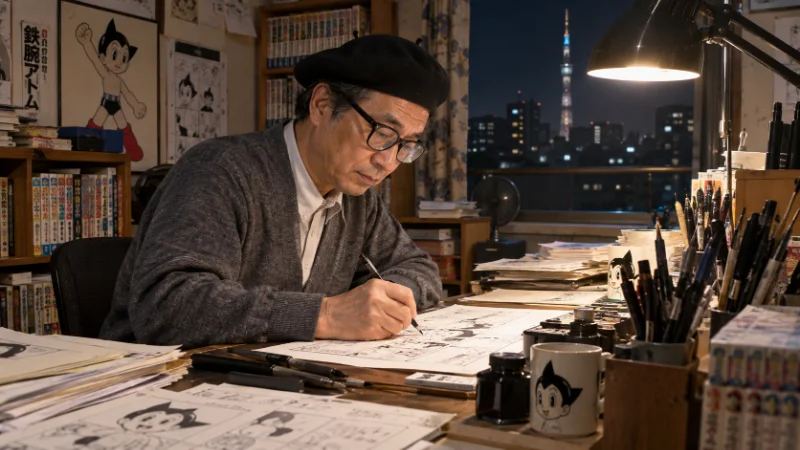
Osamu Tezuka was a legendary Japanese manga artist and animator whose pioneering work earned him the title of the “God of Manga.” Born in 1928, he revolutionized the medium by introducing cinematic storytelling, expressive character designs, and dynamic panel layouts that set the standard for modern anime and manga. Tezuka studied medicine before pursuing drawing full-time, bringing narrative depth and complex philosophical themes to works created for both children and adults.
His landmark creation, Astro Boy (Metsuwan Atom), introduced in 1951, became a global cultural phenomenon and defined the visual language of Japanese animation. Beyond Astro Boy, Tezuka produced over 700 manga series, including masterpieces like Black Jack, Kimba the White Lion, and Phoenix. His prolific career transformed Japanese pop culture into a global empire, leaving behind an artistic legacy that continues to influence storytellers, animators, and readers worldwide.
Who Was Osamu Tezuka
Osamu Tezuka is the reason American audiences ever saw a Japanese cartoon on television. Before “anime” was a word most people in the United States recognized, there was Astro Boy, a robot boy with rocket feet who ran on NBC affiliate stations in 1963. Tezuka made him, along with roughly 700 volumes of manga and dozens of animated series that reshaped how comics and cartoons are made in Japan and, eventually, everywhere else.
He trained as a physician, held a medical license, and never worked a single day as a doctor. Instead, he drew. Over four decades, he produced an estimated 150,000 pages of manga, according to Tokyo Weekender, working on three hours of sleep and sometimes none. He died in 1989, still holding a pen, with his final major series unfinished on the drawing table.
Early Life in Osaka
Tezuka was born on November 3, 1928, in Toyonaka, in Osaka Prefecture, the eldest son of Yutaka and Fumiko Tezuka. His mother regularly took him to the Takarazuka Revue, the all-female musical theater company based in his hometown, and its stagecraft shaped how he later thought about pacing and spectacle on the page.
As a teenager, he adopted the pen name “Osamushi,” a play on his given name and the Japanese word for beetle, a nod to his childhood obsession with insect collecting. During World War II, while still in high school, he was drafted into factory labor supporting the war effort and kept drawing manga in whatever scraps of time he had.
In 1945, he entered Osaka University to study medicine, and he completed his degree there in 1951, earning a medical license he would later use mostly as material for his own stories rather than as a career.
A Career Built on Reinvention
Tezuka published his first professional work, “Maa-chan’s Diary,” in a children’s newspaper in 1946, while still a medical student. The real breakthrough came a year later with “New Treasure Island,” a 1947 manga that reportedly sold around 400,000 copies and helped establish the visual language that would define his career: large, expressive eyes borrowed in part from the Disney and Fleischer cartoons he grew up watching, including a reported eight viewings of “Bambi” to study its animation frame by frame.
Through the 1950s, he became one of Japan’s most prolific manga artists, moving between genres that most publishers at the time treated as separate markets: science fiction, medical drama, historical epic, and stories aimed squarely at children. That refusal to stay in one lane became one of his defining traits.
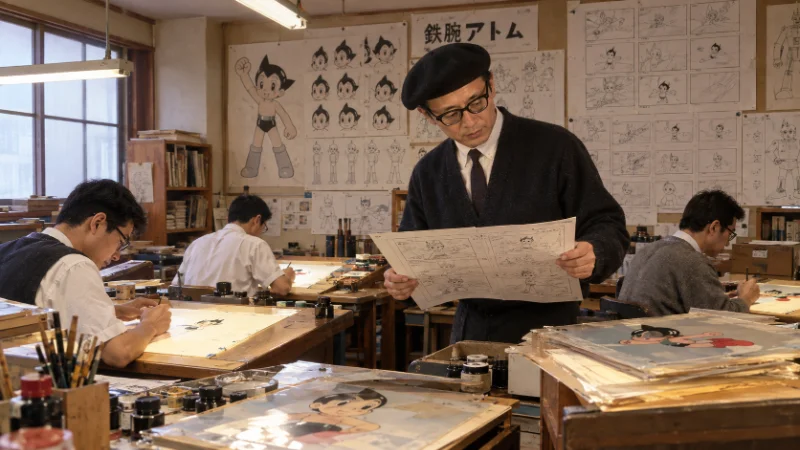
In 1961, he founded the animation studio Mushi Production, and two years later he adapted his own manga “Tetsuwan Atom” into “Astro Boy,” Japan’s first weekly animated television series. It ran in the United States on NBC affiliate stations starting in 1963, dubbed into English, and became many American viewers’ first exposure to Japanese animation, even though most had no idea at the time that it had come from Japan at all.
The Setbacks Behind the Success
Tezuka’s story is not a straight climb. Mushi Production expanded fast through the 1960s, taking on ambitious projects, and by 1973 the studio had gone bankrupt, a collapse that reportedly left Tezuka personally covering debts for years afterward. Around the same period, younger manga artists working in the gekiga style, a grittier and more realistic approach aimed at adult readers, were pulling audiences away from the storytelling he had pioneered.
Rather than retreat, Tezuka adapted. In 1973, he launched “Black Jack,” a manga about an unlicensed surgeon that drew directly on his own medical training, and it became one of his most acclaimed works. He also founded Tezuka Productions in 1968 to keep making manga and animation on his own terms after the Mushi Production collapse. Through the 1970s and into the 1980s, he kept producing major series, including “Buddha,” a multi-volume account of the life of Siddhartha Gautama, and continued work on “Phoenix,” a science fiction epic about death and reincarnation that he considered his life’s most important work and never finished.
The Work That Defined Him
Tezuka’s catalog spans an unusually wide range for one creator. “Astro Boy” gave Japan its first television anime icon. “Kimba the White Lion,” known in Japan as “Jungle Emperor,” followed a young lion navigating leadership and loss, and later drew comparisons to Disney’s “The Lion King” that Tezuka’s estate and fans have debated for decades. “Dororo” reimagined the Sengoku period as a horror adventure. “Message to Adolf” used three men named Adolf, one of them Hitler, to examine identity and nationalism during World War II.
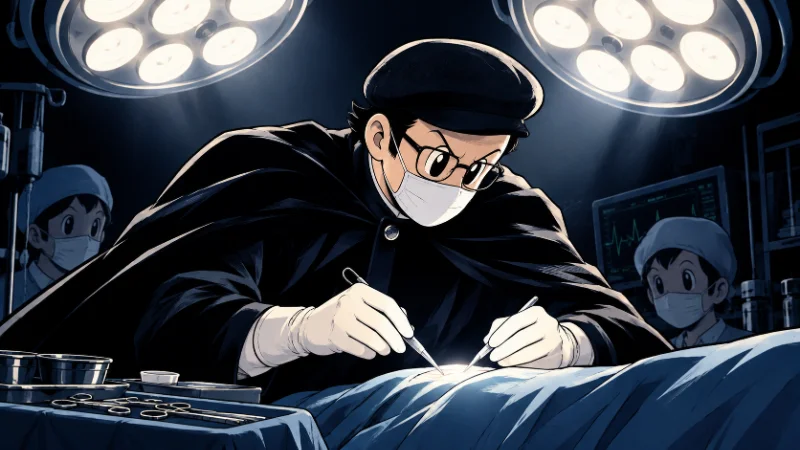
What tied these together was less genre than technique. Tezuka is widely credited with popularizing a cinematic style of paneling in manga, using varied panel sizes and pacing borrowed from film to slow down or speed up a scene, a technique now standard across the medium. He also reused character designs across unrelated stories in what he called his “Star System,” treating his characters like actors who could play different roles in different productions.
Final Years and Death
Tezuka kept working through declining health in the 1980s. He was diagnosed with stomach cancer and continued drawing from his hospital bed. He died on February 9, 1989, at age 60. According to widely reported accounts from those close to him, his last words to his staff were a plea to let him keep working, though biographers note this line comes from secondary retellings rather than a single verified transcript. What is documented is that chapters of “Phoenix” remained unfinished on his desk.
Why Tezuka Still Matters in the United States
Most Americans encountered anime for the first time because of Tezuka, whether they knew his name or not. “Astro Boy” opened a door that later let “Kimba the White Lion,” and eventually the broader wave of Japanese animation that reached American cable television in the 1990s and 2000s, through it. Studios that Americans now associate with anime, from Studio Ghibli to Production I.G., grew out of an industry structure Tezuka helped build, including the practice of licensing manga into television animation as a business model rather than a novelty.
His influence on American comics has been more indirect but real. Creators working in graphic medicine, a genre that uses comics to explore illness and the body, regularly cite “Black Jack” as an early example of the form. Manga’s foothold in American bookstores, which by the 2000s had become a fixture of the graphic novel section, traces back to English translations of Tezuka’s own work published starting in the 1970s and expanded through the 1990s by translators including Frederik Schodt, whose writing helped introduce American readers to manga as a serious art form rather than a children’s curiosity.
Awards and Lasting Recognition
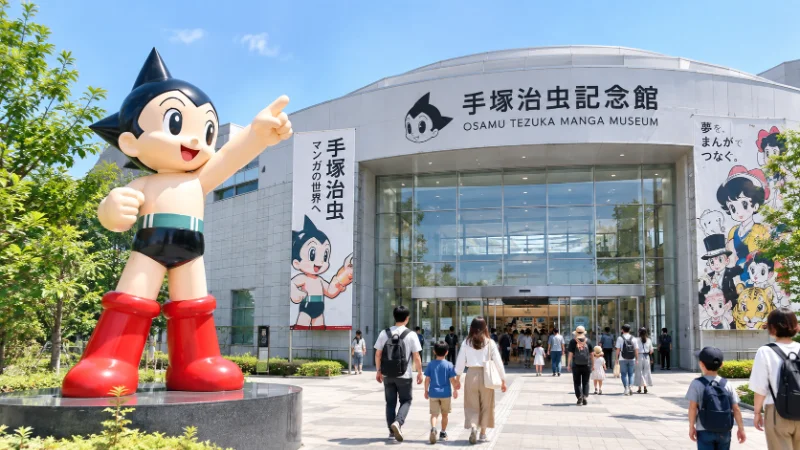
Japan opened the Tezuka Osamu Manga Museum in his hometown of Takarazuka in April 1994, five years after his death, turning his archive into a public exhibition space. In 1997, Japan issued postage stamps in his honor and created the Tezuka Osamu Cultural Prize, an annual award still given to manga artists whose work reflects his spirit of genre experimentation. He is commonly referred to in Japan as “manga no kamisama,” the god of manga, a title that has stuck for more than three decades since his death.
Osamu Tezuka did not simply draw comics. He treated manga as a medium capable of handling medicine, war, religion, and death with the same seriousness as literature, then built the studio system that carried those ideas onto television screens in Japan and, eventually, into American living rooms. The work he left unfinished on his desk in 1989 is still being read, translated, and adapted today, which is about as close to proof of a lasting legacy as a career can get.